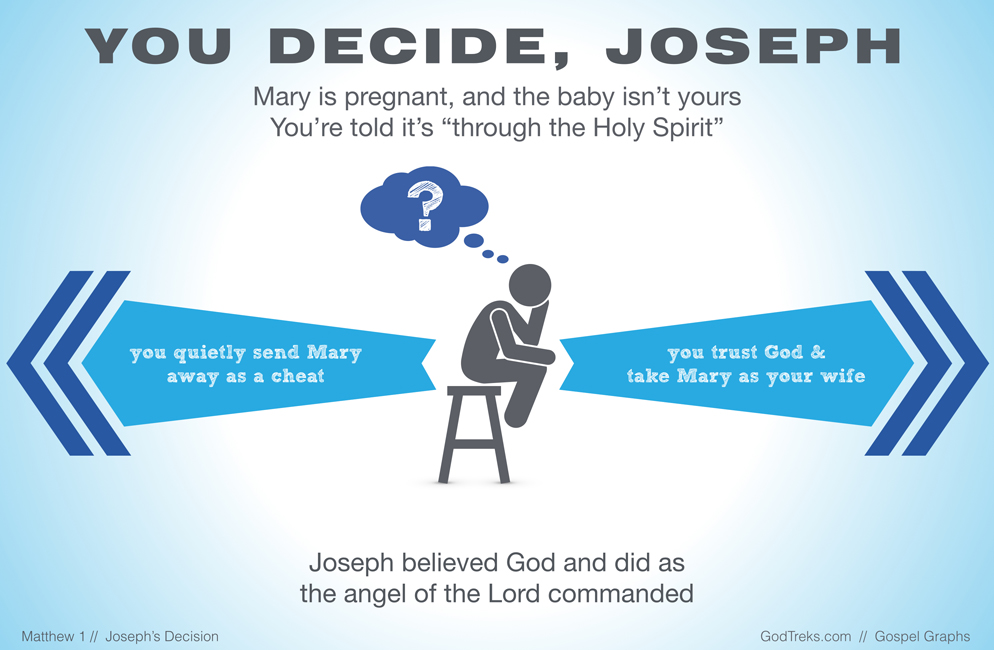
Put yourself in Joseph’s place. Mary, the woman you’re betrothed to, is pregnant, and you know the baby isn’t yours. She swears that she’s been faithful to you, that she’s pregnant not by man but through the power of the Holy Spirit. You love her and want badly to believe her, but this is a thing unheard of. How can you accept this incredible claim? It flies in the face of everything you know to be true. You have to quietly send Mary away from you. The law says she should be stoned, but you don’t want that. Enough has been lost already.
Friends, God’s plan for Joseph and his family was so incredible he could not accept it until an angel of the Lord appeared to him in a dream and confirmed Mary’s story. Even then, he could have decided to send Mary away. Even then, he faced a hard choice. To take Mary as his wife meant embracing stigma and scandal. To believe and obey God meant losing reputation and standing in the world. Tongues would always wag about the circumstances of Jesus’s birth. But Joseph chose to trust God. He chose to believe God’s unbelievable plan, to take Mary as his wife, and to become the earthly father of the Son of God.
As Pastor Charles Edward Jefferson shows, Jesus will always be our standard. Perfectly poised, beautifully balanced, He is our guide and our goal.
Behold, the ideal man!
“By the poise of Jesus I mean the fine balance of his faculties, the equilibrium of his nature. . . . How rarely do we find well-balanced men! The average man is one-sided, unsymmetrical, unevenly developed. . . . We are all overdeveloped on one side of our nature and underdeveloped on the other. It seems to be well-nigh impossible to keep our faculties in even balance. If we are strong in certain characteristics, we are well-nigh certain to be weak in the opposite characteristics.”
“If we are imaginative, very imaginative, unless we are on our guard we become flighty and visionary. If we are practical, very level-headed, we are always in danger of becoming prosaic and dull. If we have courage in great abundance, our courage passes readily into recklessness. If we are prudent, our prudence is always on the point of degenerating into cowardice. If we are original and unique, our uniqueness is always in danger of passing into eccentricity. If we are sympathetic, our sympathy is likely to run into sentimentalism. If we are pious, our piety has a tendency to become sanctimoniousness. If we are religious, our religion tends to slip into superstition.”
“But when we come to Jesus we find ourselves in the presence of a man without a flaw. . . . He was imaginative, full of poetry and music . . . but he was never flighty. He was practical, hard-headed, matter of fact, but he was never prosaic, never dull. His life always had in it the glamour of romance. He was courageous but never reckless, prudent but never a coward, unique but not eccentric, sympathetic but never sentimental. Great streams of sympathy flowed from his tender heart to those who needed sympathy, but at the same time streams of lava flowed from the same heart to scorch and overwhelm the workers of iniquity. He was pious, but there is not a trace about him of sanctimoniousness. . . . He was religious, the most profoundly religious man that ever turned his face toward God, but never once did he slip into superstition.”
Balance of Powers
“Because he is so well-rounded and on every side so complete, men have never known where to class him. Of what temperament was he? It is impossible to say. Every man on coming to him finds in him what he wants. He had in him all the virtues, and not one of them was overgrown. He exhibited all the graces, and every one of them was in perfect bloom. He stands in history as the one man beautiful, symmetrical, absolutely perfect.”
“Out of this balance of his powers comes his unrivaled poise in conduct. . . . Men laid their traps and tried to catch him, he walked bravely in the midst of them and never was entrapped. The intellectual athletes of his time tried to trip him — they never did. His enemies did their best to upset him — they never could. They flung their lassos at his head — they never got a lasso round his neck. They dug their pits — he never tumbled into them. Wherever he went he was surrounded by enemies waiting to catch him in his talk — they never caught him. They asked him all sorts of questions, expecting that by his answers he would incriminate himself — he never did.”
“Time and again the evil one came to him with a new allurement, but every time he hurled the tempter back by quoting just the passage of Scripture which that temptation needed. Men tried to convict him of breaking the law in regard to the Sabbath day, but instantly he proved from Scripture and from reason that what he did was right. . . . When Peter at Philippi began to protest against his going to Jerusalem where he would be killed, Jesus said, ‘Get thee behind me, Satan.’ He had heard that voice before. He recognized it even on the lips of his friend. It is one of the devil’s last resources to speak through the mouth of a friend. Such a trick cannot deceive Jesus.”
Grace Under Pressure
“All the different parties united their forces . . . and concocted schemes by means of which this young prophet should be brought to prison. The Pharisees go to him with this question: ‘Is it lawful to pay tribute to Caesar?’ It was an insidious question. If he said ‘yes,’ then that would make him hateful to every patriotic Jew, for no Jew who had a patriotic heart believed it was right to pay Jewish money into a Gentile treasury. If on the other hand he said ‘no,’ then he proved himself to be a traitor to Rome, and the Roman officials could immediately pounce down on him. What will he do? Holding a piece of money in his hands he says, ‘Whose superscription is this?’ And when they say ‘Caesar’s,’ he hands the money back to them, saying, ‘Render unto Caesar the things that are Caesar’s, and unto God the things that are God’s.’ The Pharisees were conceited people, but after that they durst ask him no more questions.”
“There was a scribe who thought he would try his hand. ‘What is the great commandment of the law?’ he said, to which Jesus replied, ‘Love the Lord thy God with all thy heart and thy neighbor as thyself.’ ‘But who is my neighbor?’ And then Jesus told him about the priest and the Levite and the Samaritan who saw the man by the wayside. After he had told the story he thrust this question into the man’s heart: ‘Which one of the three was neighbor to the man who fell among the robbers?’ After that the scribes asked him no more questions.”
“He is seized and carried before Caiaphas, and the marvelous poise of the prophet disconcerts and dumfounds the high priest. Unable to do anything with him he sends him to Pilate. Pilate questions him and becomes afraid of him. What a picture! The prophet of Galilee erect, calm, immovable, saying, ‘To this purpose was I born, and for this end came I into the world, to bear witness to the truth.’ See Pilate cringing, cowering, shuffling, washing his hands and saying he does not propose to have anything to do with such a man. Jesus has poise, and Pilate, representative of the Eternal City, servant of an empire of blood and iron, has no poise at all.”
“It is an interesting fact that though Jesus was speaking constantly in public for three years, not one of his enemies was able to catch him in his speech, and when at last they convicted him they had to do it on a trumped-up lie. This also is noteworthy that not one of the enemies of Jesus was able by unfairness or falsehood or hatred to push Jesus into a hasty word or an unrighteous mood. Most men are so poorly balanced you can push them with very little pressure . . . into an unchristian disposition. Jesus was so firmly poised that under the pressure of the most venomous vituperation that has ever been hurled against a man, he stood erect, unmoved, and immovable. His poise was divine.”
A Man for All Seasons
“Because he is so well balanced and so finely poised, each generation comes back to him for inspiration. Is it not remarkable that the men of the first century thought they saw in him the ideal figure of what a man should be, and that men in the fourth century looking at him felt the same, and that men in the tenth century looking at him felt the same, and that men in the sixteenth century looking at him agreed with all the centuries that went before, and that men in the twentieth century looking at him feel that in him they find a perfect pattern?”
“Men of intellect who live the intellectual life look to him for guidance and instruction, men of emotion who desire to replenish the springs of feeling look to him for inspiration, men of high aspirations who desire to lift the soul sit humbly at his feet confessing that he has the words of life. And now that new and complicated problems have arisen in commercial life, and industrial life, and social life, men are turning wistfully to him, feeling that he has the key which will unlock all the doors, that he knows the secret of a complete and perfect life. There is a grace about him which does not fade, there is a sanity about him which compels respect, there is a charm about him which woos and wins the heart, and we like preceding generations fall down before him acknowledging that his character is without a flaw and that his life is without a blemish.”
Excerpts from The Character of Jesus by Charles Edward Jefferson (Thomas Y. Crowell & Co., 1908)
There’s never been a knight like Jesus of Nazareth. Pastor Charles Edward Jefferson explains why, with a look at the chivalry of God.
Sir Jesus
“I have found difficulty in finding a word to express the quality of Jesus to which I now desire to invite your attention. This quality is courage, but it is something more than courage. . . . He was heroic but he was more than that. His heroism was a superb gallantry and something more. There was in it a delicious courtesy, a beautiful and gentle graciousness toward the weak and helpless. Possibly we can find no better word to cover this rich characteristic of the heart of Jesus than the word ‘chivalry.'”
“Jesus of Nazareth was a knight. On foot he traveled forth, clad in the armor of a peerless manhood, to shield the weak, maintain the right, and live a life which should charm and win the world. At the head of the great company of knightly souls by whose bravery and prowess the world has been made better, stands this knight of knights, this chivalric Man of Galilee.”
Jesus, Peerless Kingdom Knight
“A knight he was at the beginning; a knight he will be to the end. Mark how his soul goes out to those who suffer. Physical distress pierced him and wrung his heart. Sickness in the first century did not receive the attention which it receives in ours. The poor were allowed to suffer unattended and to die unrelieved. There were no hospitals such as ours, and no earnest bands of philanthropic men and women giving their lives to the alleviation of pain and to banishing the terrors of the dying hour. Insane people were not housed and cared for.”
“Jesus pitied them. No one else reached out to them a helping hand. The evangelists take delight in telling us how again and again he healed those who were afflicted with demons. . . . Even the leper was not beyond the reach of Jesus’ heart. Men turned their backs upon him. Laws prescribed the distance which he must keep from every other human being. Between him and all others there was a deep gulf fixed, but this Knight of Nazareth crossed the chasm and to the consternation of all Palestine . . . laid his hand upon him.”
Friend of the Neglected and Forlorn
“His heart was ever open to the neglected and forlorn. . . . There were people who were estranged from organized religion. They neglected the observances and regulations of the synagogue and were labeled ‘sinners’ by the pious. They were not in all cases profligates or vagabonds, but simply men and women who had no liking for the ceremonies of the church and who took no interest in the rabbis or their teachings. The rabbis in return took no interest in them.”
“In many of these people there were aspirations after better things, and in all of them there were the deep hungers and warm feelings of our common humanity. But they were outcasts. The church had laid a ban upon them.”
“No one who cared for his reputation as a God-fearing man dared to associate with them. No rabbi in all Palestine would risk his good name by dining with any one of them. But Jesus was not a man to be deterred. . . . The so-called sinners were human beings, and because children of God they were not to be despised. If no other religious teacher would go among them, he would. He did. He made himself of no reputation. He sat down with sinners and ate with them.”
Redeemer of Traitors and Tax Collectors
“Among the so-called sinners there was a group of men lower than all others, known as publicans. These were tax collectors whose business it was to collect Jewish money and send it up to Rome. The tax collector is never a popular personage, and if he collects money to send to an outside and tyrannical power he is not only unpopular but execrated. The publicans of Palestine were hated with a fury of detestation which modern society cannot parallel.”
“Publicans were counted lower than street dogs. The Jewish church would not allow them even to contribute to its treasury. But Jesus made friends of these men. They were friendless, and in many cases of unsavory character, but he was a physician, and like all true physicians he was especially interested in those who were dangerously ill. . . . Not only did he eat with them, but when the time came to select twelve men who should be his most intimate friends and most conspicuous workers, one of them was a publican.”
Champion of Women and Families
“When was a knight ever so reckless in throwing his protection round the weak? But as is the case with all true knights, it is in his attitude to women that Jesus’ chivalry reaches its finest expression. . . . Of all the knights who have risked their lives for the protection and honor of womanhood not one is worthy to unloose the latchet of the shoes of this gracious and gallant Man of Galilee.”
“How boldly he spoke on the subject of divorce. . . . In Palestine a woman was at the mercy of the man. A man could divorce his wife when he chose, and all that the law required was that he should write out a statement declaring that whereas this woman was once his wife she was now his wife no longer. But against such arbitrary and dangerous authority the chivalric soul of Jesus protested. . . . A man has no right to cast a woman off as soon as he is tired of her. Marriage is ordained by God. . . . God intends that one man shall live with one woman and that they shall live together until death parts them.”
“No greater words than those have ever been spoken on behalf of women since the world began. Even now men’s hearts are too hard to hear and heed them, and the result is degradation, heartbreak, and misery. High above all the clamorous voices of the world there rings the clear and authoritative tone of Jesus saying to men: ‘You have no right to use women and toss them from you. Man and woman belong together, and after marriage the twain are one flesh.'”
God, Protector of the Weak and Maintainer of the Right
“Here, then, we have a knight who is a knight indeed. The medieval knight went forth seeking for adventures; our knight of Palestine went forth in search of forlorn and friendless human beings. . . . His was the skill of a physician and not that of a soldier. His was the prowess of a friend and brother and not that of a warrior fighting to lay his antagonist in the dust.”
“He had all the graces and virtues of medieval chivalry and none of its superficiality or foibles. He had the nerve, the mettle, and the intrepidity of the bravest of the knights, and with this he had a sweet winsomeness, a divine graciousness which history cannot match. . . . This prince of knights, this king of all the hosts of chivalry, conquered on every field and came off without a stain.”
“In Jesus we have a revelation of the heart of God. . . . God is knightly in His disposition, chivalric in His temper. It is His work from all eternity to protect the weak, maintain the right, and live a stainless life. His heart goes out unceasingly toward the weak, the helpless, and those who have no friend. If you are conscious of your weakness, cry out to Him, for He is swift to answer such a cry. If you feel sometimes absolutely helpless, altogether forlorn and forsaken, do not despair, for the heart of Jesus is the heart which beats in and behind all this world, and you can never be forsaken so long as God is God.”
Excerpts from The Character of Jesus by Charles Edward Jefferson (Thomas Y. Crowell & Co., 1908)
Jesus said, “Give, and it will be given to you” — a hundred times over. He gave. As Pastor Charles Edward Jefferson shows, He gave everything.
The greatest of all gifts was Himself
“‘It is more blessed to give than to receive.’ These words express with rare fullness one of the finest of the traits of Jesus, his generosity. If one were asked to mention a half-dozen key words of Christian duty, he would be sure to place the word ‘give’ high in the list. One cannot read the New Testament without being halted by that word, for it occurs repeatedly, and always with an emphasis which arrests the heart. Indeed, it has been often claimed that the Man of Galilee is wild and reckless in his theory of giving. His saying, ‘Give to him that asketh thee, and from him that would borrow of thee turn not thou away,’ has been to many a mystery and an offence.”
“But the exhortation need stagger no one. . . . Mortals are urged to give as God gives, and God’s giving is always fashioned and conditioned by his love. He does not give to every man the precise thing which the man asks for. He says to all of us not once but many times, ‘No,’ ‘no,’ ‘no!’ Love can never give where giving would work hurt. The mother cannot give the razor to the little girl who pleads for it, nor can the father grant his son every favor which he asks. The man half drunk who begs for a quarter on the street corner must be refused. In every case the petitioner must be dealt with according to the requirements of the law of love.”
“To write down all the considerations and qualifications which must be taken into account . . . was for Jesus a plain impossibility. It was better to throw out the great word ‘give,’ unqualified and naked, allowing it to speak unhindered to the human heart, as a word which holds in it a revelation of the mind of God. . . . When Jesus was unfolding his idea of generosity, he said: ‘Give, and it shall be given unto you; good measure, pressed down, and shaken together, and running over. . . . For with the same measure that ye mete withal it shall be measured to you again’. . . . He says to all, ‘Freely ye have received, freely give.'”
Generous Teaching
“Jesus’ dislike of the stingy and parsimonious heart comes out in several of his parables. When he speaks of the rich man in his fine linen at his banquet table while the sick beggar eats crumbs at his gate, we can feel the hot flame of an indignant soul. When he tells of the rich man who thought of nothing but his overflowing barns and his own selfish enjoyment, there is a scorn in his language which scorches.”
“When he sees a poor widow throwing her two bits of copper into the treasury in the temple, all the money she had in the world, he does not criticize her for doing a foolish thing as most of us would have done, but he cries out in a shout which has in it the music of a hallelujah, ‘She has given more than them all.’ In a world so filled with grudging and close-fisted men, it cheered his great heart to see now and then a person who had mastered the divine art of giving.”
Poured Out
“He liked givers because he himself was always giving. . . . When he urged men to give freely, abundantly, lavishly, gladly, continually, he was only preaching what he himself practiced. He had no money to give, but he gave without stint what he had. He had time and he gave it. The golden hours were his and he gave them. He gave them all. So recklessly did he give them that in order to find time to pray it was necessary to use hours when other men were sleeping. He had strength and he gave it, with a liberality which astonished and alarmed his friends. He poured out his energy to the last ounce.”
“He had thought and he gave it. He had ideas and he scattered them. He had truth and he shared it with men. Behold a sower goes forth to sow! It is Jesus. Look at him. Watch the swing of that arm. What a generous arm! He scatters the seed upon the beaten path. No matter. He scatters the seed on the soil that is rocky. What of it? He scatters the seed in brier patches and thorny corners. He does not mind that. The seed is abundant, and he will scatter it with a prodigal hand, hoping that some of it will find the soil which is fertile and which will bring forth a harvest to make glad the heart of God. . . . His affection toward men flowed in a stream constant and full. His sympathy covered all classes, and no individual, however low and despised, ever appealed to him in vain.”
“Having given time and strength and thought and sympathy and love, he finally gave up his life. More than this can no man give. He was not an unwilling victim of circumstances, or the helpless prey of ungovernable political forces. . . . He gave his life consciously and deliberately. It was not snatched from him by accident or fate, but freely surrendered by a heart willing to pay the great price. . . . ‘I have power to lay down my life,’ he said, ‘and I have power to take it again.’ It was his conviction from the beginning that he came into the world to minister to men’s needs, and to give his life as ransom for many. It was only by giving his life that he could soften men’s hearts and bring a lost world back to the Father.”
Extravagant Nature
“This, then, was the earthly career of Jesus — one continuous manifestation of generous and boundless love. In his character we see not only what is possible for man to be, but we also behold a revelation of the character of the Eternal. . . . The God revealed by Jesus is the same God revealed by Nature. . . . The days and nights, the sky and sea and land, the changing seasons, all bear witness to His amazing generosity. He is prodigal in all His doings. He is lavish in all His benefactions.”
“He scatters the stars not in paltry thousands but in countless millions. He creates flowers not in numbers which we can count, but in a profusion which confuses and confounds the imagination. He always gives more than can be accepted. He throws sunsets away on eyes which do not care for them. He gives fruit trees more blossoms than the trees can use. At every feast which He spreads there are fragments remaining filling twelve baskets. He is a munificent, free-handed, bountiful, and extravagant God.”
“He runs constantly to profusion and exuberance and overflowing plenty. He fills the measure, presses it down, shakes it together, and causes it to run over. . . . He breaks the alabaster box upon our head every day we live. He spreads a table before us, He makes our cup run over. There are a thousand toothsome things to eat, and a thousand lovely things to see, and a thousand exquisite pleasures to experience, and a thousand sublime truths to learn, and a thousand good opportunities to seize — more than we can ever make use of in the short span of life allowed us. In the realm of nature He is assuredly a lavish and bewilderingly bounteous God.”
“And what He is in the world of nature He is likewise in the realm of the spirit. Jesus says, ‘Ask and ye shall receive.’ Do not hesitate to do it. No matter who you are, you may do it. ‘For everyone that asketh, receiveth.’ It is an eternal principle, deep-seated in creation and deep-rooted in the heart of God, that gifts rich and royal may be had for the asking. It is the purpose of the Christian religion to bring us to a God who is willing to give us above what we are willing to ask or able to think. The generosity of Jesus is intended to remind us of the measureless beneficence of the all-Father. His message thrills with the thought that we constantly get not what we earn or what we deserve, but what an ungrudging and open-handed God is delighted to give.”
Love Gives
“If you ask why was Jesus generous, the answer is, God is love. When was love anything but liberal? When has love ever dealt out good things with a scant and skimping and miserly hand? When Peter suggested a certain number as being enough to indicate the limits of forgiveness, Jesus told him not to count at all. Love never counts. When did a mother ever count the number of times she kissed her baby, and when did a friend ever catalogue the number of favors toward his friend, or when did a parent ever make a list of all the good things he gave his children? Love never counts. It is the nature of love to give, and to keep on giving, and then to devise new ways of larger giving, and to imagine still additional needs which may be supplied.”
“Jesus says: ‘What man is there of you, who, if his son shall ask him for a loaf, will give him a stone; or if he shall ask for a fish, will he give him a serpent? If ye then being evil know how to give good gifts unto your children, how much more shall your Father which is in heaven give good things to them that ask him?’ If you are ever tempted to question the generosity of the heart of God, look at Jesus! Once in the world’s history there has lived a man whose supreme joy was ungrudging giving. He knew as no other man has ever known how much more blessed it is to give than to receive. He lived not to be ministered unto, but to minister; not to receive, but to give; not to save his life, but to pour it out for others. If generosity so great has appeared in Time, it must be because there is a generous heart in Eternity; if a grace so beautiful has blossomed on our earth, we have a right to expect the same grace in heaven.”
Excerpts from The Character of Jesus by Charles Edward Jefferson (Thomas Y. Crowell & Co., 1908)
People often pretend and conceal. But as Pastor Charles Edward Jefferson shows, Jesus was always sincere, always authentic, always truly Himself.
The opposite of every form of deceit
“There is an adjective which the word ‘friend’ will not keep company with, and that is the adjective ‘insincere.’ You cannot induce them to stay together in the same room. They flatly contradict each other. The moment we find out that a comrade is insincere with us, he ceases to be our friend. Sincerity is the very blood and breath of friendship. . . . There is nothing which so takes the life out of us as the discovery that someone whom we have trusted has been other than what he seemed to be.”
“And yet how common insincerity is. What a miserable old humbug of a world we are living in, full of trickery and dishonesty and deceit of every kind. Society is cursed with affectation, business is honeycombed with dishonesty, the political world abounds in duplicity and chicanery, there is sham and pretense everywhere. . . . The life of many a man and many a woman is one colossal lie. We say things we do not mean, express emotions we do not feel, praise when we secretly condemn, smile when there is a frown on the face of the heart, give compliments when we are thinking curses. We strive a hundred times a week to make people think we are other than we really are.”
“Thank God there are hearts here and there upon which we can depend. . . . It is to the honest heart that we return again and again, seeking rest and finding it. It is a fountain at which we drink and refresh ourselves for the toilsome journey. Beautiful, indeed, is the virtue of sincerity. It is not a gaudy virtue. It does not glitter. It has no sparkle in it. But it is substantial. It is life-giving. It sustains and nourishes the heart. . . . There are some things we cannot be, and many things we cannot do. But this one thing is within the reach of us all — we may ask God unceasingly to keep our heart sincere.”
Tell the Truth
“Would you see sincerity in its loveliest form, then come to Jesus. Here is a man incapable of a lie. Nothing was so abhorrent to him as falsehood. No other people so stirred his wrath as men who pretended to be what they were not. The most odious word upon his lips was ‘hypocrite.’ Have you ever wondered why it is impossible to speak that word without it falling from the lips like a serpent — it is because his curse is resting on it. . . . He breathed the hot breath of his scorn into it, and it has been ever since a word degraded and lost.”
“A hypocrite and Jesus cannot live together. It was his constant exhortation that men should speak the truth. The religious leaders of his day had divided oaths into two classes — one class binding, the other not. If an oath contained the name of God, it was binding on the conscience; if for God’s name some other name was substituted, then the conscience might go free. Jesus was disgusted by the reasoning of the bat-eyed pettifoggers. ‘Do not swear at all,’ he said. ‘Let your communication be yea, yea, nay, nay.’ In other words, ‘If you want to render a thing emphatic, simply say it over again. If men doubt you, then quietly repeat what you have already declared.'”
“It was the belief of Jesus that a man’s word ought to be as good as his oath. . . . If the world were the kind of world God wants it to be, then all the evidence that would be needed to prove a certain thing true would be that a man had asserted it. If it is necessary now in courts of justice to make use of oaths, it is because the Evil One has corrupted many hearts and rendered the ordinary speech of humanity unreliable. In an ideal world all oaths are unnecessary.”
Use Plain Words
“It was because of Jesus’ incorruptible sincerity that we have from his lips such a remarkable outpouring of plain words. You and I do not like plain words. We dare not use them — at least often. We water our words down. We pull the string out of them. We substitute long Latin words for plain, short, Anglo-Saxon words, for by multiplying the syllables we attenuate the meaning. For instance, we say ‘prevarication’ instead of ‘lie,’ because falsehood when expressed pompously loses its blackness and grossness.”
“But Jesus would not use words of velvet when words of velvet flattered and deceived. It was his work to help men see themselves as they were. He characterized them by words which accurately described their character. One day he told a crowd in Jerusalem that they were of their father the devil and the lusts of their father they were eager to do. He went on to add that the devil was a murderer and that he abode not in the truth because the truth was not in him. We are shocked by such plainness of speech. We do not like it. Is that because we dare not express things as they are? Have we gotten into the habit of hiding our eyes and trying to make black things seem gray or even white?”
Do Not Conceal
“Jesus was incorrigibly sincere. . . . There was a strong inducement for him to conceal his extraordinary knowledge. A man makes himself odious by claiming to know more than other men. . . . But Jesus was a man of truth. He could not disguise the fact that his knowledge was unique and that his power was unparalleled. Because he was true he could not hold back the fact that he was the Good Shepherd and the Door, the Bread of Life, and the Light of the World. Nothing but sincerity would ever have driven him to outrage the feelings of his countrymen by assertions so extraordinary. . . . These remarkable declarations of his in regard to the nature of his personality and the range of his power were forced from his lips by a heart unswervingly loyal to the truth.”
“The warnings of Jesus have often aroused criticism and condemnation because of their severity. . . . He told certain men they were moving onward to perdition and painted their loss and ruin in phrases which have caused the human heart to shudder. How will you account for such vigor of language? It was certainly cruel to speak such words if he did not know the possibilities and doom of sin. If he knew, then he was bound to tell. The awful parables of the New Testament are the product of a heart that was uncompromisingly sincere. To speak soft words to men whose feet are hastening down the road to ruin, how was it possible to do it? His very sincerity drove him into language which to our cold hearts seems exaggerated and needlessly abusive.”
“He called the leaders in Jerusalem liars, blind men, fools, serpents, vipers. If they were not all this, then Jesus stands condemned for making use of such cutting words. But suppose these men were precisely what such words described, then what? Suppose they were in fact liars and fools and blind men, was it not the duty of Jesus to inform them of their pitiable condition? What else could a sincere friend do? These men supposed they could see and were wise, but if they were mistaken was it not incumbent on an honest man to deliver them if possible from their delusion? . . . The Lord of truth must use words which accurately characterize the persons who are to be instructed and warned.”
Trust in Truth
“The inmost heart of Jesus finds utterance in his declaration to Pontius Pilate that he had come into the world to bear witness to the truth. That was his work. He never shirked it. He never grew weary in doing it. He was surrounded all his life by men who bore witness to falsehoods. . . . They misrepresented his deeds and his words and his motives. They filled the air with lies. . . . But in the midst of the despicable set of false-minded, false-hearted maligners and murderers, he stood forth, calm, radiant, the one man in all the world whose lips had never been sullied by a falsehood and whose heart had never been stained by a lie.”
“This unquestioned loyalty to truth gives his words a value which no other words possess. When we listen to the words of other men, we must make subtractions and allowances. No man puts his whole self into his speech. His words reveal him and they also conceal him. There is a discrepancy between the soul and what the mouth declares. Not so with Jesus. He holds back nothing. What he thinks he says, what he feels he declares. . . . He declares all things as they are. He is not swerved by sin within nor cowed by hostile forces from without.”
“This, then, is the man we want. . . . To him we can flee when sick at heart because of the deceptions of the world. . . . When men disappoint us and friends are few, we can come to one who says, ‘I am the truth.’ When we are weary and heavy-laden, we can rest our souls upon one who is as certain as the morning and as faithful as the stars. The world is filled with jangling voices and it is hard to know which voice to trust; but his voice . . . inspires assurance and quenches uncertainty and doubt.”
“What he teaches about God we can receive. . . . What he declares of sin and the penalty of sin we can accept. What he tells us of the soul we can depend upon. What he asserts concerning the principles of a victorious life we can act upon, never doubting. When he tells us to do a thing we can do it, assured that it is the best thing to do. When he warns us against a course of action we can shun it, knowing that in that direction lie night and death. The path which he exhorts us all to take we can take with boldness, convinced that if we take it we shall arrive safe at home at last.”
Excerpts from The Character of Jesus by Charles Edward Jefferson (Thomas Y. Crowell & Co., 1908)
No one has ever spoken more candidly than Jesus. No one has ever opened more of his heart. Pastor Charles Edward Jefferson explains.
Candor is key to an open heart
“In modern speech candor is openness. . . . It is a rare virtue, one of the most winsome of all the virtues. Many a man does not possess it. He is taciturn, reserved, secretive. He keeps the door of his heart shut. When he says a thing you cannot tell how much he means, for you do not know the extent of his reservations. When he does a thing you cannot tell what he is going to do next, because you do not know how fully his act has embodied all which exists in his heart. . . . He is the man with the barred lips and the bolted heart. Such a man may be respected and even admired, but he cannot be loved. Jesus was loved. Men loved him so intensely they were willing to die for him. One reason was that he was a man with his heart open.”
Candid Praise
“One obtains a hint of a man’s disposition by noting the men whom he admires and praises. . . . Nathaniel was a citizen of a small Galilean village, Cana, situated not far from Nazareth. As soon as Philip had gotten a little acquainted with Jesus he was desirous of bringing Jesus and his friend Nathaniel together. . . . Nathaniel had a deep-seated contempt for dingy little Nazareth, and all that was in his heart came out in the cynical question, ‘Can there come any good thing out of Nazareth?’ He was nothing if not frank. His friend, not at all daunted, mildly said, ‘Come and see.'”
“As soon as Jesus sees him coming toward him he exclaims in a tone musical with praise, ‘Behold an Israelite indeed in whom is no guile.’ This was the sort of man which won at once the heart of Jesus. There was no craft nor cunning in him, no duplicity nor deceit; he was a man of frank sincerity, and Jesus’ heart immediately goes out to him, assuring him that over his open soul there is going to be an open heaven. Outspoken and frank himself, Jesus was en rapport with souls which were free from guile.”
“And here we find one of the reasons why Jesus always extolled the disposition of a child. . . . The child heart is always the open heart. Where can you find such candor, such beautiful frankness, such surprising and sometimes discomfiting outspokenness as in a little child? He will tell you just what he thinks, all he thinks, nothing will he hold back. He will make known his feelings, all his feelings, and will melt and overcome your heart by the fullness of his naive self-revelation. One of the reasons why Jesus set a child in the midst of the disciples, saying, ‘This is what you ought to be,’ is because a little child is the embodiment and personification of candor.”
Candid Condemnation
“A man reveals himself in his dislikes as truly as in his praises. Whom did Jesus most dislike? The Pharisees. They were hypocrites. A hypocrite was an actor, a man who wore a mask, the mask representing a personality other than the one inside of it. ‘Do not be like the actors,’ this was his constant exhortation, and he never lost an opportunity of holding up the hypocrites to contempt and scorn. On one occasion he faced them in Jerusalem, calling them to their face ‘vipers.’ It was a harsh word, and yet it expressed the inmost spirit of the men to whom it was applied. They were as venomous and deadly as vipers.”
“It is an awful thing to tarnish the name of God and render religion odious, and to poison the heart of the world. Yet all this these hypocrites were doing, and to the guileless heart of Jesus there were no men so repulsive and deserving of scorching condemnation. He was himself so genuine and open-hearted that the craft of these treacherous actors stirred him to blazing indignation.”
Candid Warning
“He never held back the truth when it was time that the truth should be spoken. . . . The Gospels teem with illustrations of this surprising and daring frankness. One day in talking with some Sadducees . . . he told them bluntly that they were always falling into error because they were so ignorant. They were ignorant both of the Scriptures and of the power of God. It was a needed word, for people who know little and think they know much are sometimes helped by having their attention called to the limitations of their knowledge; but to give such reprimand is not an easy thing to do. It was by his outspokenness that Jesus attempted to cure some of the infirmities of men.”
“He will hold back nothing. The whole terrible truth must be told. No man shall ever follow him without first knowing what risks and dangers discipleship involves. Read the tenth chapter of Matthew as a shining illustration of his candor. He wants the twelve to do his work, but before they start they shall know what sort of experiences they may reasonably expect. ‘Behold I send you forth as sheep in the midst of wolves’. . . . Beginning thus he goes on to paint a picture black enough to daunt the heart of the bravest, and the only encouragement he has to give them for facing such awful dangers is the promise that he will confess them at last before his Father in heaven.”
“When men rushed to him saying, ‘Master, I will follow you,’ he flashed on them the gloom of a dark sentence, unwilling to accept the allegiance of anyone, even in times when he most needed support, without having first revealed . . . the full significance of a place in his ranks. Men’s heads were filled with dreams of supremacy and sovereignty and glory, and more than one heart was chilled by the searching question, ‘Are you able to drink the cup?’ His candor reduced the number of his followers, but it was just like him to hold back nothing.”
Candid Confession
“But it is in his confessions that his candor reaches its climax. . . . He admits without hesitation that there was a limitation of his authority. One day a man interrupted him with the cry, ‘Speak to my brother that he divide the inheritance with me,’ and the reply was, ‘Man, who made me a judge or a divider over you?’ There was a realm then in which Jesus was not ordained to act. . . . The nation had long pictured a king who should put an end to the cruel inequalities with which the world was cursed, and measure out justice with an even hand. And now the Messiah deliberately turns his back on a man who is pleading for justice, saying that into that realm he cannot now enter. Only a strong man is brave enough to disappoint his friends by candidly admitting that it is impossible for him to do what they have expected of him.”
“More surprising was his confession of ignorance. . . . Jesus frankly admitted that there were things which he did not know. For instance, one day he was talking in graphic phrase about the end of the world. He spoke so definitely and positively that it was a natural inference that he knew when it would take place. To the amazement of his hearers he said, ‘Of that day and that hour knoweth no man, not the angels in heaven, neither the Son, but only the Father’. . . . Candid, indeed, is the teacher who confesses his ignorance. Jesus confessed his.”
“Let us be thankful that Peter was frank enough to tell Mark just what Jesus said, and that Mark was sincere enough to write down just what Peter reported, and that Matthew in a book written especially to prove that Jesus was the long-expected Messiah and King of Israel, did not shrink from writing down the great confession of Jesus’ ignorance as to the day and the hour of the end of the world. The New Testament is like its hero, gloriously candid.”
Candor and Confidence
“Nothing inspires confidence in a man like candor. If a man is frank and open in nine points, we may safely trust him in the tenth. Jesus makes his candor a reason why his disciples ought to trust him in those realms of thought and life which lie beyond their sight. ‘In my Father’s house are many mansions, if it were not so I would have told you.’ Of course he would. It was his nature to tell men everything it was necessary for them to know. He would not allow his friends to go on holding delusions when a word from him would set them free. . . . Like all normal and unspoiled men they believed that death is not the end. . . . Jesus allowed them to nourish these expectations. . . . He let them go on thinking of heaven, hoping for heaven, working for heaven.”
“On his candor, then, we have a right to build both for time and eternity. When he says that if we do not repent we shall perish, and that only those who are born from above enter the kingdom of light, we have every reason for believing that these statements are true. And when he says that his disciples are going to do greater things than were ever done in Palestine, and that he will be with us always even unto the end of the world, why should we not believe him? And since he is so frank and open with us why should not we be open-hearted and frank with him? If he tells us truly the things in his heart, why should we not tell him truly the things which are in our hearts? He has given himself to us: why do we not give ourselves to him?”
Excerpts from The Character of Jesus by Charles Edward Jefferson (Thomas Y. Crowell & Co., 1908)








 GodTreks